
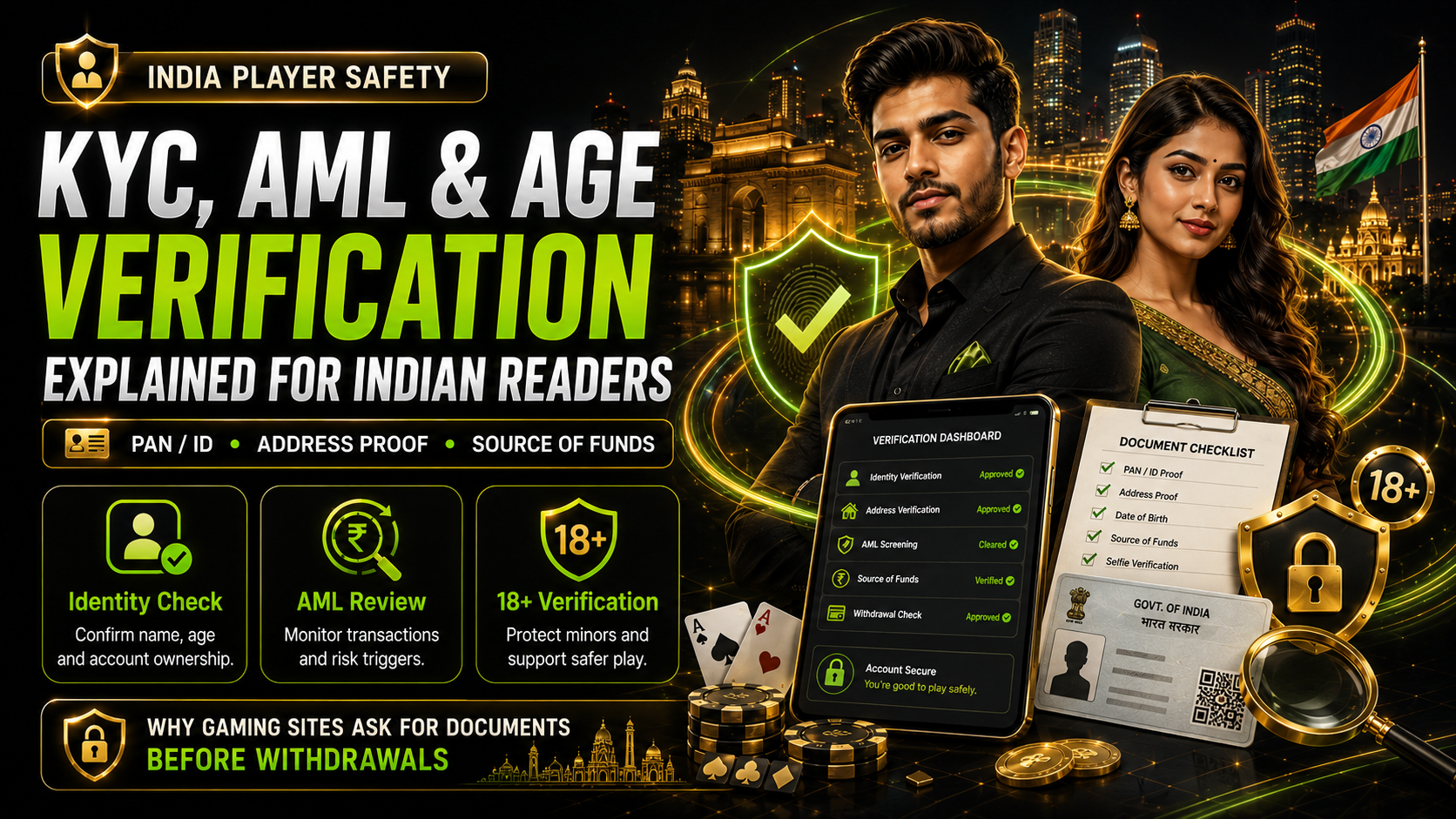
KYC, AML and age verification are among the most misunderstood parts of online gambling, casino, poker, betting and real-money gaming accounts. Many users only notice them when a site suddenly asks for PAN, passport, driving licence, address proof, a selfie, or source-of-funds documents before processing a withdrawal.
The short answer is simple. KYC means Know Your Customer, AML means Anti-Money Laundering, and age verification confirms that a user is old enough to access restricted services. These checks are common in regulated environments, but they do not automatically prove that a site is lawful or low-risk for Indian users.
What Each Check Actually Means
KYC is the identity layer. It can include name, date of birth, address, nationality, payment ownership, and account uniqueness. AML is the transaction-monitoring layer. It focuses on suspicious patterns, payment mismatches, duplicate accounts, and source-of-funds review. Age verification is the consumer-protection layer that helps stop under-age access.
- KYC often checks legal name, date of birth, address, ID and payment ownership.
- AML often checks deposits, withdrawals, suspicious activity, third-party payments and enhanced due diligence.
- Age verification may use date of birth, ID documents, selfies, or manual review.
Why Sites Ask for PAN, ID or Address Proof
Indian users usually see these requests during withdrawal review, after a risk trigger, or after a first deposit. The operator may want to confirm identity, verify age, match the payment method to the account, investigate suspicious activity, or apply internal compliance rules.
The request itself is not automatically suspicious. What matters is whether the site explains its KYC flow clearly, provides a document checklist, has visible policy pages, and tells users how long a review may take.
Why Verification Often Happens Before Withdrawal
From the user perspective, delayed KYC feels unfair. From the operator perspective, withdrawal is where identity, payment ownership, bonus compliance, and AML risk become most important. That is why many sites allow deposits first but request documents before the first payout or after a risk event.
- Some sites verify at registration.
- Some verify after the first deposit.
- Some wait until the first withdrawal.
- Some only trigger review when account activity looks unusual.
Source of Funds and Common Delay Triggers
A source-of-funds check goes beyond basic KYC. It asks where deposited money came from and may require bank statements, salary proof, tax documents, business records, e-wallet history, or crypto transaction details. This does not automatically mean wrongdoing, but it does raise the importance of privacy policy, document handling, and support quality.
Many delays happen because of simple mistakes: nickname instead of legal name, wrong date of birth, blurry images, expired ID, payment made from another person’s card, or multiple accounts created for the same bonus flow.
What Indian Readers Should Check First
- Find the legal operator name and registered company details.
- Check the licence claim, regulator name, and licence number.
- Read the KYC, AML, privacy, and withdrawal policy pages.
- Confirm that age restrictions and responsible-gaming tools are visible.
- Check whether the site explains restricted countries and local legal responsibility.
Red Flags Worth Taking Seriously
- No visible KYC or AML page.
- No legal operator name or licence number.
- No privacy explanation for uploaded documents.
- “No KYC” marketing combined with terms that still allow full verification later.
- Withdrawal rules that stay vague until after deposit.
- No support route or escalation path for rejected documents.
Key Takeaways
KYC, AML and age verification are standard risk-control tools, not proof of legality. A site can have identity checks, policy pages, and foreign licence claims while still being risky for Indian users under local rules. The safest approach is to treat verification as one part of a bigger trust review that also includes operator identity, payment rules, responsible gaming, support quality, and local law.